
-
Market Perspectives
Hope Spring Eternal
April 2026
- Filename
- Market Perspectives April 2026.pdf
- Format
- application/pdf
.jpg "Charles Boettcher, CPWA®")
TRANSCRIPT
A little longer presentation this month – we’ve finished the first quarter and there’s a lot to talk about.
Let’s do a quick first quarter recap, then shift attention to the ever-changing and challenging geopolitical environment, but first some perspective looking back to last April and then a quick and fun historical note.
As much as we have had to endure early springtime volatility, consider our shared experience this time last year. Last April, we were wrestling with the fallout from Liberation Day. The President declared raising tariffs on U.S. imports to levels not seen in a century, stocks and bonds plunged, the S&P 500 peak-to-trough touched bear market levels down 20%, worse than what we’ve experienced this year. Economists and CEOs warned of recession, then a week later, the President backtracked. We all wrung our hands and gnashed our teeth at various moments, but Armageddon didn’t happen. History may not repeat, but sometimes it does rhyme.
Maybe T.S. Eliot was on to something when he wrote, “April is the cruelest month.”
Fun fact: Apple turns 50 this year. Our first trillion-dollar company is a well-known story. Other than the advent of the iPhone in 2007, the thing that stood out was the groundswell of voices claiming the stock’s imminent demise when Steve Jobs died October 2011. At the time, the stock was trading around $14 a share. Today, it’s touching $260.
Let’s recap the first quarter – S&P 500 was down 4.3%, value outperformed growth (it was actually flat for the quarter). Dividend stocks did well, the Dow Jones Dividend Index was up more than 8% in the quarter. S&P 500 small-cap stocks rose about 3.5%. S&P 500 mid-cap stocks returned 2.5%. International developed stocks, measured by the MSCI EAFE Index, were down just 1.24% and Emerging Market stocks, measured by the MSCI Emerging Market Index, fell just 24 basis points. All things considered, the equity markets have demonstrated resilience amid the volatility.
Market Response
Source: Bloomberg and RBC Rochdale. As of March 23, 2026.
Information is subject to change and is not a guarantee of future results.
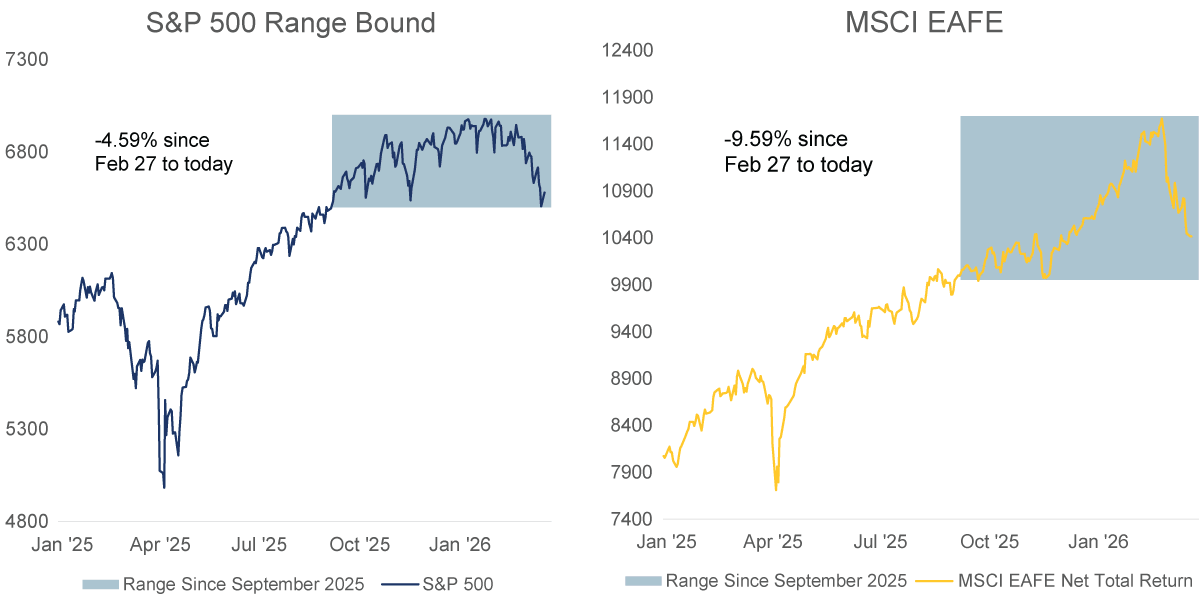
Chart 1, 2:25— The S&P 500 has remained somewhat range-bound since September 2025, demonstrating stability despite disruptions. U.S. markets benefit from energy independence, currency stability and robust infrastructure, acting as a “ballast” for global investors.
Stress has been higher for energy-import-dependent regions (e.g., Europe, Asia ex-Japan), which have seen larger drawdowns since the start of the war due to growth concerns and inflationary pressures. For example, the MSCI EAFE Index dropped more than 9.6% from February 27th to March 23rd, reflecting heightened sensitivity to conflict. It has since rebounded slightly.
Valuation
Source: Bloomberg, RBC Rochdale. MVA = Moving Average. As of March 23, 2026.
Information is subject to change and is not a guarantee of future results.
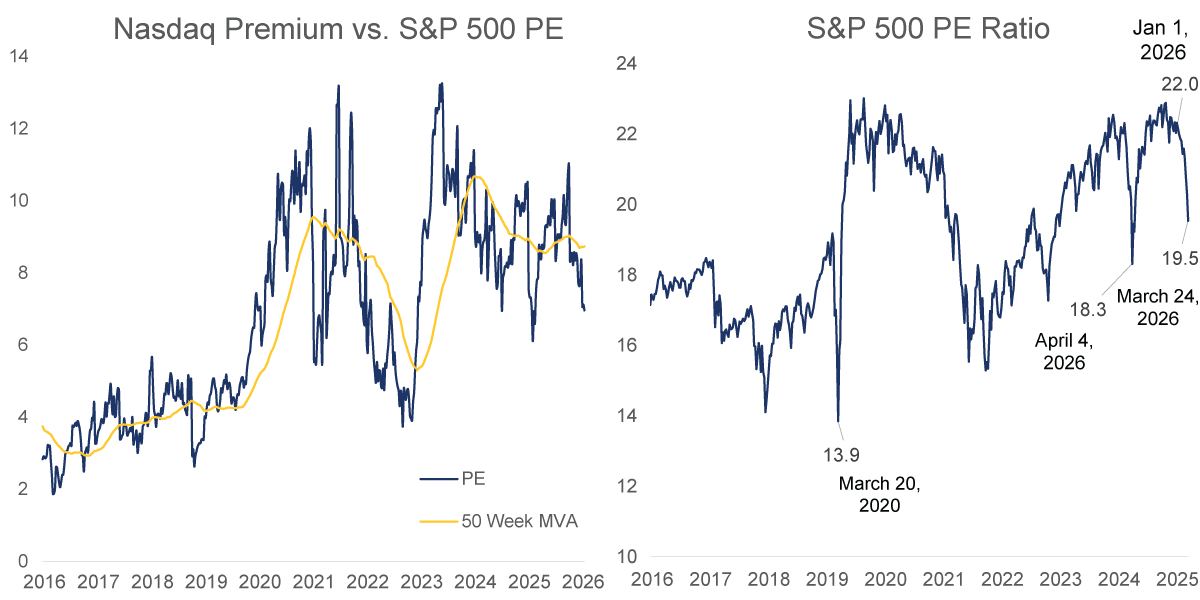
Chart 2, 3:06— Market valuations have become more attractive. The NASDAQ 100 Premium vs. S&P 500 P/E ratio has fallen to levels last seen during 2025 tariff concerns, signaling potential oversold conditions. Non-U.S. markets, despite steeper declines, offer strategic entry points due to intra-year valuation resets.
Before this week’s announcement of a two-week cease-fire, markets had been improving, the S&P was up over 3% the prior week of March 30th.We saw a gradual increase in ships moving through the Strait of Hormuz, and now with gaining confidence that a more permanent shutdown may be avoided. Obviously, the ceasefire announcement was well-received, stocks rallied strongly and oil dropped more than 17% the following morning.
Markets are starting to shift from reacting to the war itself to focusing on how it might be resolved, and that’s helping stabilize equities and oil. The cease fire is encouraging, but it is likely too early to declare that uncertainty and volatility are behind us. If the ceasefire holds and we shift to a post conflict scenario, solid and supportive fundamentals will return to focus, and we expect stocks have room to appreciate.
In summary, while energy disruptions and geopolitical risks have dominated headlines, markets have demonstrated relative resilience and adaptability. Investors should focus on quality assets, monitor central bank policies, and leverage U.S. market resilience.
Importantly, earnings season kicks off next week. Broadly, we expect good results and our 2026 estimate is still for 11-13% corporate profit growth.
Important Information
The views expressed represent the opinions of RBC Rochdale, LLC which are subject to change and are not intended as a forecast or guarantee of future results. Stated information is provided for informational purposes only, and should not be perceived as personalized investment, financial, legal or tax advice or a recommendation for any security. It is derived from proprietary and non-proprietary sources which have not been independently verified for accuracy or completeness.
While RBC Rochdale believes the information to be accurate and reliable, we do not claim or have responsibility for its completeness, accuracy, or reliability. Statements of future expectations, estimates, projections, and other forward-looking statements are based on available information and management's view as of the time of these statements. Accordingly, such statements are inherently speculative as they are based on assumptions which may involve known and unknown risks and uncertainties. Actual results, performance or events may differ materially from those expressed or implied in such statements.
All investing is subject to risk, including the possible loss of the money you invest. As with any investment strategy, there is no guarantee that investment objectives will be met and investors may lose money. Diversification does not ensure a profit or protect against a loss in a declining market.
Equity investing strategies & products. There are inherent risks with equity investing. These risks include, but are not limited to stock market, manager or investment style. Stock markets tend to move in cycles, with periods of rising prices and periods of falling prices.
RBC Rochdale, LLC is an SEC-registered investment adviser and wholly-owned subsidiary of City National Bank. Registration as an investment adviser does not imply any level of skill or expertise. City National Bank is a subsidiary of the Royal Bank of Canada.
Index Definitions
The Standard & Poor’s 500 Index (S&P 500) is a market capitalization-weighted index of 500 common stocks chosen for market size, liquidity and industry group representation to represent U.S. equity performance.
Nasdaq, Inc. is a global financial services corporation that operates as a stock exchange, providing trading, clearing, technology, and listing services.
The Nasdaq 100 (NDX) is a stock market index tracking 100 of the largest, most actively traded, non-financial companies listed on the Nasdaq exchange. It is heavily weighted toward technology, consumer services, and healthcare, acting as a benchmark for growth-oriented, innovative, large-cap companies.
The MSCI EAFE (Europe, Australasia, and Far East) Index captures large and mid-cap representation across 21 countries, including Japan, UK, and France, that measures the equity market performance of developed markets outside of the U.S. and Canada. It captures roughly 85% of the free float-adjusted market capitalization in each country.
PE (Price-to-Earnings) ratio measures a company's current share price relative to its per-share earnings, acting as an indicator of market valuation, often called an earnings multiple.


 Top
Top