
-
Market Perspectives
March Comes in Like a Bear
March 2026
- Filename
- Market Perspectives March 2026.pdf
- Format
- application/pdf
.jpg "Charles Boettcher, CPWA®")
TRANSCRIPT
What a difference a month makes! This time last month, my biggest concern was what to get my wife for Valentine’s Day. The Iran conflict is weighing on global markets, causing volatility spikes as commodity supply shocks mount and uncertainty reigns.
March Comes in Like a Lion Bear
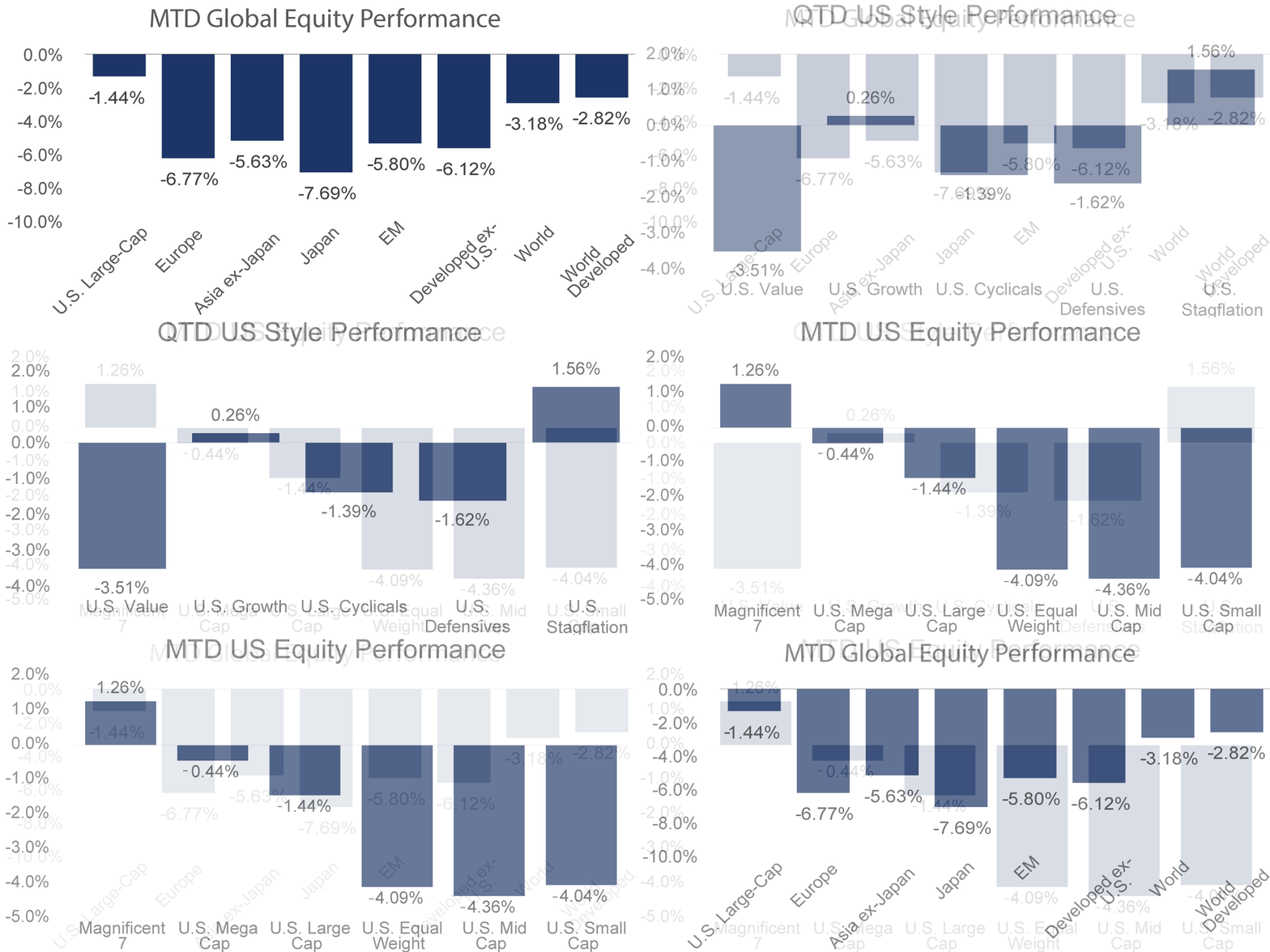
Source: Bloomberg, RBC Rochdale. As of 3/12/2026. Sectors and industries are S&P 1500 sub-indices.
Information is subject to change and is not a guarantee of future results.
Chart 1, 0:29— Most major equity markets have pulled back in March, with U.S. large-cap holding up better so far. Further, U.S. growth stocks, after lagging for the first two months of the year, have been the better relative performers this month. In the upper right-hand chart, you can see the Magnificent 7 are posting positive March returns, and larger cap stocks are faring better than smaller cap. Decent earnings reports have helped, particularly Oracle’s, which eased some of the AI bubble concerns. The three best-performing sectors month-to-date are energy (no surprise there), information technology and communication services.
For now, the focus is on the conflict and the closure of the Strait of Hormuz. The outcome remains fundamentally unknowable. The closure of the strait is the primary focus for global oil markets. Energy price volatility is a dominant narrative, but the uncertainty surrounding the duration of closure is the fundamental driver.
The International Energy Agency is asking member countries to release 400 million barrels of reserves and has secured roughly two-thirds of commitments. Asian countries plan an “immediate release,” while the U.S. and Europe aim for the end of the month.
This past Sunday, Energy Secretary Chris Wright said there are “no guarantees” that oil prices will fall soon. In addition, on Saturday, the Iranian government said the Strait of Hormuz is to remain closed to the U.S., Israel and their allies.
The single most important factor for calmer markets remains the “reopening” of the strait — not an end to the conflict.
The regional impacts vary: The U.S. is somewhat insulated by low natural gas prices and shale availability, while Europe and emerging markets are more vulnerable to energy shocks — especially natural gas.
Some of our pre-conflict assumptions have been challenged. For example, consider the Federal Reserve’s path for the rest of the year. In February, Fed futures were pricing in two cuts in 2026, but now they are pricing in a 70% chance of just one cut. The Fed may be in a tough spot: Prolonged elevated energy prices are inflationary, while recent data suggest that labor is weakening. For those remembering their economics courses, these are two ingredients for potential stagflation.
Our current perspective on possible portfolio adjustments is as follows:
- Depending on portfolio weight, a tactical reduction in oil-sensitive equity exposure (e.g., energy sector stocks) may be warranted, assuming conflict resolution is weeks, not months, away.
- Maintain flexibility to pivot if market conditions change (e.g., if there are excessive sell-offs).
- We view any major equity weakness an opportunity to buy, and the sell-off in non-U.S. equities creates a natural entry point, or a cause to add, for global positioning.
For now, investors will need to tolerate the heightened volatility. We at RBC Rochdale will continue to closely monitor whether any of these events develop enough to merit a change in our fundamental thesis.
Important Information
The views expressed represent the opinions of RBC Rochdale, LLC which are subject to change and are not intended as a forecast or guarantee of future results. Stated information is provided for informational purposes only, and should not be perceived as personalized investment, financial, legal or tax advice or a recommendation for any security. It is derived from proprietary and non-proprietary sources which have not been independently verified for accuracy or completeness.
While RBC Rochdale believes the information to be accurate and reliable, we do not claim or have responsibility for its completeness, accuracy, or reliability. Statements of future expectations, estimates, projections, and other forward-looking statements are based on available information and management's view as of the time of these statements. Accordingly, such statements are inherently speculative as they are based on assumptions which may involve known and unknown risks and uncertainties. Actual results, performance or events may differ materially from those expressed or implied in such statements.
All investing is subject to risk, including the possible loss of the money you invest. As with any investment strategy, there is no guarantee that investment objectives will be met and investors may lose money. Diversification does not ensure a profit or protect against a loss in a declining market.
Equity investing strategies & products. There are inherent risks with equity investing. These risks include, but are not limited to stock market, manager or investment style. Stock markets tend to move in cycles, with periods of rising prices and periods of falling prices.
RBC Rochdale, LLC is an SEC-registered investment adviser and wholly-owned subsidiary of City National Bank. Registration as an investment adviser does not imply any level of skill or expertise. City National Bank is a subsidiary of the Royal Bank of Canada.
Index Definitions
The Standard & Poor’s 500 Index (S&P 500) is a market capitalization-weighted index of 500 common stocks chosen for market size, liquidity and industry group representation to represent U.S. equity performance.
The MSCI Emerging Markets (EM) Index captures large-and-mid-cap representation across emerging markets countries. The index covers approximately 85% of the free float-adjusted market capitalization in each country. The MSCI Europe Index captures large-and-mid-cap representation across developed markets (DM) countries in Europe. The index covers approximately 85% of the free float-adjusted market capitalization across the European developed markets equity universe.
The MSCI World ex U.S.A. Index captures large-and-mid-cap representation across 22 of 23 developed markets (DM) countries—excluding the United States. DM countries include Australia, Austria, Belgium, Canada, Denmark, Finland, France, Germany, Hong Kong, Ireland, Israel, Italy, Japan, Netherlands, New Zealand, Norway, Portugal, Singapore, Spain, Sweden, Switzerland and the UK. With 1,011 constituents, the index covers approximately 85% of the free float-adjusted market capitalization in each country.
The MSCI All Country World Index (ACWI) is a global stock index that encompasses nearly 3,000 companies from 23 developed countries and 25 emerging markets.
The MSCI All Country (AC) Asia ex Japan Index is a free float-adjusted market capitalization-weighted index designed to capture large and mid-cap representation across both Developed Markets (DM) and Emerging Markets (EM) in the Asian region.
The index represents large-cap stocks, generally defined as companies with market capitalizations over $10 billion. Small-cap stocks are generally defined as companies with a market capitalization between $300 million and $2 billion. Mid-cap stocks are generally defined as companies with a market capitalization between $2 billion and $10 billion. Mega-cap stocks are generally defined as companies with market capitalizations over $200 billion.
The seven tech titan stocks are a group of high-performing and influential companies in the U.S. stock market: Alphabet, Amazon, Apple, Meta Platforms, Microsoft, NVIDIA, and Tesla.
The S&P 500® Equal Weight Index (EWI) is the equal-weight version of the widely used S&P 500. The index includes the same constituents as the capitalization weighted S&P 500, but each company in the S&P 500 EWI is allocated a fixed weight or 0.2% of the index total at each quarterly rebalance.
US Value: Securities that are considered underpriced relative to their fundamental intrinsic value.
US Growth: Companies expected to grow sales and earnings at a faster rate than the market average, often reinvesting profits rather than paying dividends.
US Cyclicals: Stocks whose performance is highly sensitive to the business cycle, thriving during economic expansions and lagging during recessions.
US Defensives: Securities that provide stable earnings and consistent dividends regardless of broader economic conditions.
US Stagflation: A specific macro-thematic basket or economic state defined by the “misery index”: the sum of the inflation rate and unemployment rate.


 Top
Top