Rochdale Speedometers: May 2026


What appeared to be a stabilizing environment as we closed December has quickly given way to a wave of global policy changes to start 2026 — arriving with an intensity we haven’t experienced in a long time. There isn’t a clean historical playbook for this combination of forces. But when the backdrop feels chaotic, our responsibility is not to react to media headlines. It is to step back and focus on what drives market returns and portfolio outcomes.
History offers an important reminder: geopolitical shocks often produce sharp initial reactions. But just as often, those early moves fade as broader economic fundamentals reassert themselves. That framework is especially relevant as we consider the latest escalation involving Iran. The economic relevance of the current conflict centers on energy.
Iran borders the Strait of Hormuz — one of the most critical oil transit corridors in the world. A meaningful disruption or prolonged closure would have global implications for supply, inflation and growth.
For now, global energy flows continue, but shippers are avoiding the Strait. The U.S. economic impact remains limited unless the conflict expands in duration or scope in a way that structurally interferes with energy infrastructure or shipping. The key variable is time. A short, contained episode would likely have modest consequences. A prolonged disruption that materially affects supply would be more consequential.
Also, it’s important to remember that there are knock-on effects for other parts of the world, especially to China. It is the largest trading partner with Iran, which has the potential to upset its energy supply. China imports about 13% of its oil from Iran, which is roughly 80–90% of Iran oil exports. So, this can have a large impact on the Chinese economy and China’s next steps could arguably be the most important component of the medium-term market impact.
More broadly speaking, in risk-off moments investors look for safe places to store their assets. When a risk-off move is geopolitically driven, investors typically turn to U.S. assets. Despite all the concern over the dollar’s direction and U.S. policy, we are seeing strength in U.S. assets and this is likely to continue over the duration of the conflict.
This relationship further supports our view that the investment opportunity developing outside the U.S. is not driven by a “sell the U.S.” narrative, but rather a shift in the fundamentals that drive non-U.S. markets, which we believe is a significant opportunity.
It is still too early to know how the conflict will evolve, but the initial response outside of energy has been orderly — a reminder that not every geopolitical shock translates into lasting economic damage. From a market perspective, the most significant development this year has been the shift in the AI narrative and the implications for credit — particularly private credit.
Earlier in 2026, enthusiasm around artificial intelligence centered on productivity gains, infrastructure investment and earnings leverage. More recently, the conversation has broadened to include labor disruption and business model risk.
There is growing concern that AI adoption could accelerate white-collar layoffs and potentially create a negative economic feedback loop. At the same time, companies like Block announced significant workforce reductions while highlighting efficiency gains from AI tools, intensifying that debate.
The pressure is not limited to employment concerns. The pullback in software companies reflects broader uncertainty around pricing power, per-user licensing models and the durability of recurring revenue streams in an environment where automation could compress seat counts or alter customer behavior.
That dynamic also extends into credit markets. Software and technology-enabled businesses represent a meaningful portion of the private credit universe, particularly within direct lending strategies. Many of these companies were financed during a period of strong growth assumptions and elevated valuations.
As sentiment shifts, lenders naturally reassess leverage, the durability of growth and refinancing timelines. While most private credit structures are senior to other debt and are underwritten around recurring revenue models, tighter conditions and greater selectivity are taking hold. The adjustment is not uniform, but it does reinforce the importance of underwriting discipline and the experience of the direct lender. It is completely understandable why this is drawing attention, but it’s important to recognize what is systemic stress and what is not.
Technological transitions create company-level adjustments. They reshape industries and alter cost structures. That does not automatically translate into economywide contraction, but the debate has driven meaningful market rotation.
For equities, at the index level, returns are essentially flat. But beneath the surface, leadership has shifted materially. Technology and Communication Services, which carried much of the earlier momentum, have experienced pressure. Energy and more defensive sectors have gained relative strength.
That level of sector dispersion tells us positioning is adjusting. Crowded trades tied to AI enthusiasm have been pared back, while capital has rotated toward areas with different earnings sensitivity. Importantly, this type of shakeout can be constructive. With valuations elevated in parts of the market, periodic resets in leadership reduce excess positioning and improve the durability of the broader advance.
Overall, Earnings will matter the most and fourth quarter 2025 results were broadly positive, advancing 13% versus an expectation of 8%. Revenue growth exceeded expectations across multiple sectors. Technology delivered strength, particularly in AI-related segments, but gains were not confined to one area. Industrials, Financials and several cyclical sectors also surprised to the upside.
Margins remained high and guidance, while slightly more measured, did not signal a sharp slowdown. In addition, earnings revisions have stabilized, reinforcing the view that profit growth remains intact.
When we step back further and examine the broader economy, the picture remains constructive. U.S. growth has moderated from post-pandemic highs but remains firmly in expansion territory. GDP readings and forward tracking estimates are running above 2%.
Consumer spending continues at a steady pace and the unemployment picture has improved. Inflation is also moving in the right direction and, while financial conditions are tighter than earlier in the cycle, they are not restrictive in a way that typically precedes a recession.
Taken together, steady growth, stable labor markets, moderating inflation, resilient earnings and contained credit stress show that this is not an economy on the brink, but one that is adjusting to a more sustainable pace of expansion.
■ Previous Month ■ Current Month
US Economic Outlook
What we see
RBC Rochdale's investment and portfolio strategy is driven by our macroeconomic analysis. Timely economic forecasting is very difficult to do but extremely important, especially as the significance of economic information to financial markets continues to rise.
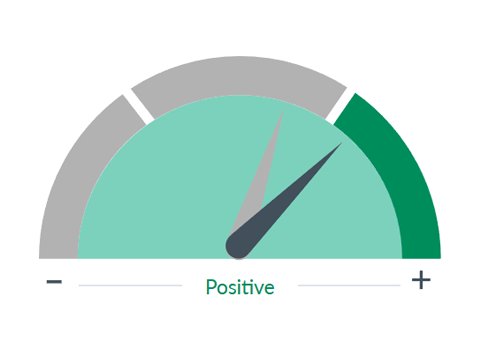
Dial 1: US Economic Outlook, 6:50— For all these reasons, we are upgrading our U.S. Economic Outlook Speedometer from yellow to green, supporting other recent moves we’ve made to support our current market outlook.
There is no question that 2026 has been fast-moving and, at times, unsettling. Geopolitical tension, rapid technological change, shifting policy direction and meaningful rotations within markets can create the impression of instability. But our process is built for precisely these kinds of environments. We focus on data and we adjust when facts change. Today, the evidence supports ongoing expansion, despite the noise.
While consumer spending remains strong, consumer sentiment has been at a low for years and has clearly been neutral in terms of its impact on markets. We view sentiment as primarily policy-related, not a reflection of the underlying economy. While sentiment may be low, it hasn’t stopped spending.
RBC Rochdale, LLC. is an SEC-registered investment adviser and wholly-owned subsidiary of City National Bank. Registration as an investment adviser does not imply any level of skill or expertise. City National Bank is a subsidiary of the Royal Bank of Canada.
The information presented does not involve the rendering of personalized investment, financial, legal or tax advice. This presentation is not an offer to buy or sell, or a solicitation of any offer to buy or sell any of the securities mentioned herein.
Certain statements contained herein may constitute projections, forecasts and other forward-looking statements, which do not reflect actual results and are based primarily upon a hypothetical set of assumptions applied to certain historical financial information. Certain information has been provided by third-party sources and, although believed to be reliable, it has not been independently verified and its accuracy or completeness cannot be guaranteed.
Any opinions, projections, forecasts, and forward-looking statements presented herein are valid as of the date of this document and are subject to change.
Rochdale Speedometers are indicators that reflect forecasts of a 6-to-9-month time horizon. The colors of each indicator, as well as the direction of the arrows represent our positive/negative/neutral view for each indicator. Thus, arrows directed towards the (+) sign represents a positive view which in turn makes it green. Arrows directed towards the (-) sign represents a negative view which in turn makes it red. Arrows that land in the middle of the indicator, in line with the (0), represents a neutral view which in turn makes it yellow. All of these indicators combined affect RBC Rochdale’s overall outlook of the economy.
RBC Rochdale, LLC., its managed affiliates and subsidiaries, as a matter of policy, do not give tax, accounting, regulatory, or legal advice, and any information provided should not be construed as such.
All investing is subject to risk, including the possible loss of the money you invest. As with any investment strategy, there is no guarantee that investment objectives will be met and investors may lose money. Diversification does not ensure a profit or protect against a loss in a declining market. Past performance is no guarantee of future results.
©2026 RBC Rochdale, LLC. All rights reserved.


 Top
Top