
-
Market Perspectives
New Year, New Paradigm?
January 2026
- Filename
- Market Perspectives January 2026.pdf
- Format
- application/pdf
.jpg "Charles Boettcher, CPWA®")
TRANSCRIPT
Happy New Year! I hope your year-end festivities were joyful. I recently marked my 31st year in investment management — January 1995 feels like a lifetime ago. Let’s quickly review the “just completed” 2025 and then shift our focus and provide a summary of our 2026 outlook.
Last year, the S&P 500 returned 17.88% —another good year for investors in U.S. stocks, but not without some hand-wringing. From late February to early April, the S&P 500 plunged approximately -20% peak-to-trough, touching bear market territory. As investors digested the potential tariff impacts, equity markets recovered. Interestingly, in 13 of the past 20 years, the S&P 500 has experienced an intra-year peak-to-trough drop of at least 10%; however, only 3 of those years produced a negative calendar year return. A reminder that short-term volatility is normal.
It has been an impressive run for the S&P 500 over the past decade; annualized returns for 3-, 5- and 10-year periods have exceeded market expectations and historical averages.
In 2025, growth outperformed value, large outperformed small and mid-cap, the tech-heavy NASDAQ was up 21.17%, and in a change from recent years, international developed stocks outperformed U.S. stocks. All major bond indices finished the year in positive territory with higher yield and longer duration strategies leading the way. Commodities were mixed; gold was a big winner while crude oil was down.
Corporate profits exceeded expectations and interest rates declined, especially on the short end as the Federal Reserve cut the Fed Funds Rate three times in 2025.
2026 Equity Market Outlook
Our base case is for the S&P 500 to be between 7600 – 7700 by year end 2026, roughly 11-12% higher. Strong and broadening earnings, fiscal and monetary policy stimulus, and a resilient consumer underpin our outlook.
Positives for Markets
Productivity gains broaden at a brisk pace | Capex spending continues at current pace
New Fed Chair & Fed voters cut rates further than est. without re-triggering inflation, reducing the cost of capital
Labor and U.S. GDP growth surprises to the upside
Consumer spending & corporate investment increase beyond expectations on strong OBBBA benefits
Further reduction in tariff rates globally | SCOTUS strikes down tariffs and administration does not reengage
Global demand, fiscal, and monetary policy stimulus surprises to the upside
Middle Column

AI
Fed & Inflation
Labor & Growth
Consumer & Business Spending
Tariffs
Global Demand & Fiscal
& Monetary Policy
& Monetary Policy
Negatives for Markets
Capex growth rates slow | Demand slows | Competition increases | Productivity gains fail to materialize
Term-premium & debt repricing concerns | Fed independence wanes | Sticky inflation prevents/slows Fed cuts
Labor market weakness persists, slowing GDP growth but remains positive
K shaped economy diverges further, slowing spending | OBBB & tax savings fail to drive business & consumer spending
SCOTUS strikes down IEEPA tariffs, causing administration to reengage in trade war activities
Global growth slows due to tariff uncertainty
Source: Proprietary opinions based on RBC Rochdale research, as of December 9, 2025. Checkmark position indicates RBC Rochdale expectations (left-side check is more positive, right-side check more negative).
Information is subject to change and is not a guarantee of future results.
Chart 1, 2:11— All things considered, a good year. Looking forward, equity markets are near record levels, reflecting solid earnings and improving visibility on inflation and policy. Technology continues to lead, but other sectors are gaining momentum. High U.S. valuations may trigger volatility. RBC Rochdale expects S&P 500 corporate earnings to grow 12.5% in 2026. Our base case for the S&P 500 to reach between 7,600 and 7,700 by year end is driven by earning growth, fiscal and monetary stimulus and a resilient consumer. Key areas are listed down the middle with possible positive and negative scenarios.
While U.S. valuations remain elevated, relative opportunities abroad are becoming more compelling as earnings expectations rise and currencies stabilize. Given the improving outlook, we plan to introduce an allocation to developed international equities.
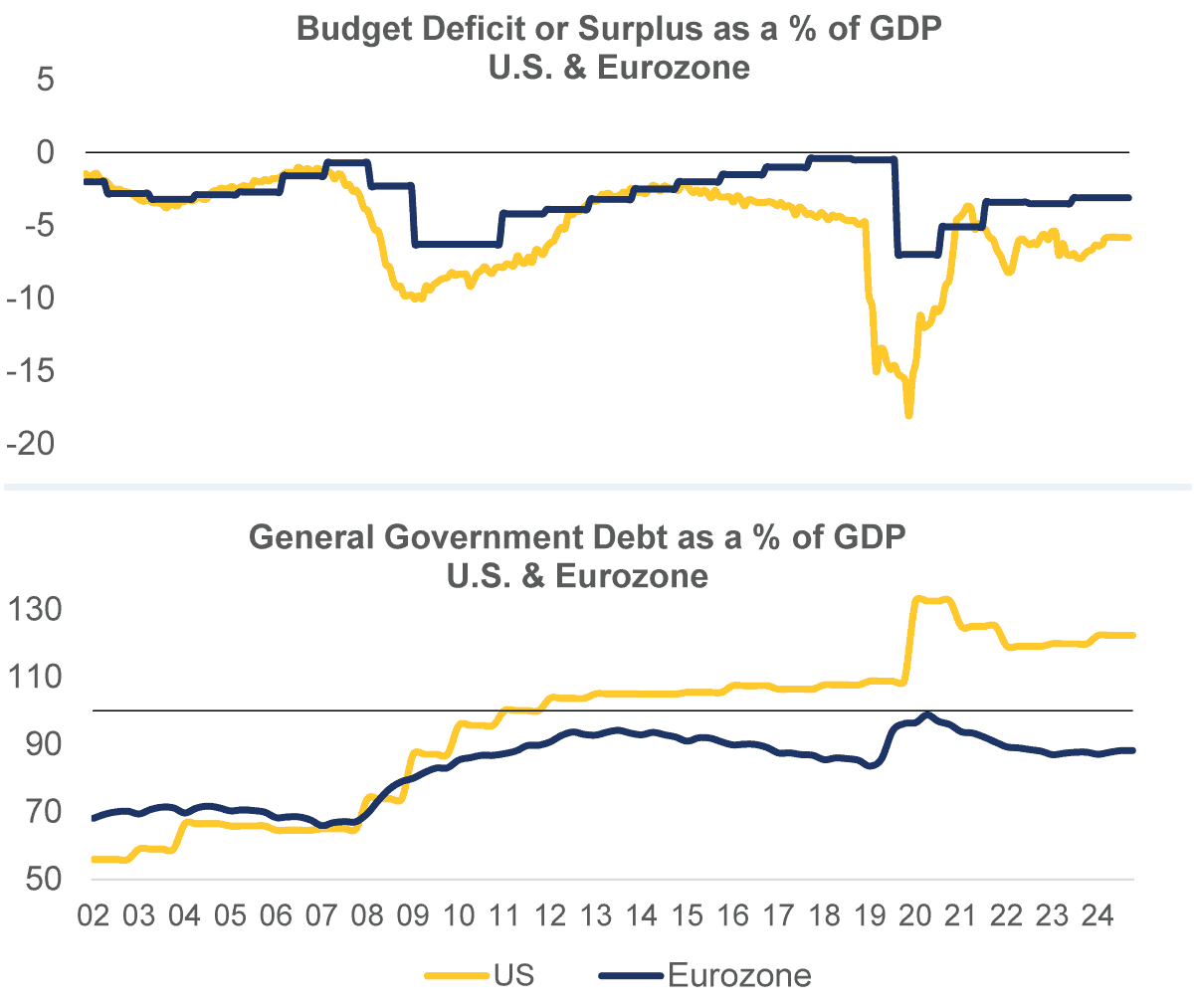
Paradigm Shift Underway in Global Markets
- Foreign governments are increasing spending with an emphasis on defense and infrastructure.
- The capacity for fiscal and monetary stimulus is greater in global markets due to lower rates and smaller debt loads.
- Declining U.S. interest rates and a softer dollar have historically driven strong performance in international markets.
Top 5 Reasons for a Long-Term
U.S. — Global Paradigm Shift
Rebalancing of Global Capital Flows
U.S. share in global markets at 1970s peak
Superior Valuations and Mean Reversion
International valuation discounts look historically attractive
Structural Policy Tailwinds Outside the U.S.
Fiscal & monetary flexibility is greater in non-U.S. markets
Weaker Dollar and the Rise of Multipolar Trade Blocs
Structural trade deficits, declining real yield advantage deliberate central bank diversification
Sectoral and Structural Advantages Abroad
U.S. market remains dominated by mega-cap technology and infrastructure companies
Source: Proprietary opinions based on RBCR research, as of December 9, 2025. Checkmark indicates RBC Rochdale expectations.
Information is subject to change and is not a guarantee of future results.
Chart 2, 3:14— U.S. stock valuations are historically wide relative to international markets, suggesting an entry point for non-U.S. allocations. Foreign governments are increasing spending with an emphasis on defense and infrastructure. The capacity for fiscal and monetary stimulus is greater in global markets due to lower rates and smaller debt loads. Declining U.S. interest rates and a softer dollar have historically driven strong performance in international markets. The U.S. market has become somewhat top-heavy with mega-tech and infrastructure companies constituting a disproportionate weight in the S&P 500, and international allocation will add to portfolio diversification.
We enter 2026 confident in the outlook for continued returns. Return dispersion remains high, making diversification and disciplined risk management essential.
Market leadership is shifting from policy-driven toward a broadening AI investment cycle that is now spreading across the economy. Geopolitical risks persist, but markets remain resilient as conflicts stabilize and a longer-term global shift improves non-U.S. opportunities. Tariff impacts are diminishing as negotiations lower rates and steady trade flows, suggesting domestic policy may be a smaller driver in 2026.
We remain constructive on equities, emphasizing AI-enabled and earnings-resilient sectors such as tech, communication services and energy, while maintaining caution in rate-sensitive areas.
Here’s to a prosperous, healthy, and happy 2026.
Important Information
The views expressed represent the opinions of RBC Rochdale, LLC which are subject to change and are not intended as a forecast or guarantee of future results. Stated information is provided for informational purposes only, and should not be perceived as personalized investment, financial, legal or tax advice or a recommendation for any security. It is derived from proprietary and non-proprietary sources which have not been independently verified for accuracy or completeness.
While RBC Rochdale believes the information to be accurate and reliable, we do not claim or have responsibility for its completeness, accuracy, or reliability. Statements of future expectations, estimates, projections, and other forward-looking statements are based on available information and management's view as of the time of these statements. Accordingly, such statements are inherently speculative as they are based on assumptions which may involve known and unknown risks and uncertainties. Actual results, performance or events may differ materially from those expressed or implied in such statements.
All investing is subject to risk, including the possible loss of the money you invest. As with any investment strategy, there is no guarantee that investment objectives will be met and investors may lose money. Diversification does not ensure a profit or protect against a loss in a declining market.
Equity investing strategies & products. There are inherent risks with equity investing. These risks include, but are not limited to stock market, manager or investment style. Stock markets tend to move in cycles, with periods of rising prices and periods of falling prices.
RBC Rochdale, LLC is an SEC-registered investment adviser and wholly-owned subsidiary of City National Bank. Registration as an investment adviser does not imply any level of skill or expertise. City National Bank is a subsidiary of the Royal Bank of Canada.
Index Definitions
The Standard & Poor’s 500 Index (S&P 500) is a market capitalization-weighted index of 500 common stocks chosen for market size, liquidity and industry group representation to represent U.S. equity performance.
NASDAQ Index: National Association of Securities Dealers Automated Quotations Stock Market
Stay Informed.
Get our Insights delivered straight to your inbox.
Put our insights to work for you.
If you have a client with more than $1 million in investable assets and want to find out about the benefits of our intelligently personalized portfolio management, speak with an investment consultant near you today.
If you’re a high-net-worth client who's interested in adding an experienced investment manager to your financial team, learn more about working with us here.


 Top
Top